
The Quiet Revolution: How Renewable Energy Is Reshaping Our World
"We are the first generation to feel the sting of climate change, and the last generation that can do something about it." — Anonymous Policy Advocate
This document is a comprehensive Markdown test file. It combines a long-form article with a wide variety of Markdown syntax elements so you can verify that your website's Markdown reader handles everything correctly — from basic emphasis to nested lists, tables, code blocks, footnotes, and embedded HTML.
Table of Contents
- Introduction
- Text Formatting
- Lists
- Links and Images
- Code
- Tables
- Blockquotes
- Task Lists
- Horizontal Rules
- Advanced Elements
- Conclusion
Introduction
For most of human history, energy came from sources we could see and touch: wood thrown onto a fire, water turning a mill wheel, wind filling a sail. The industrial era changed that relationship entirely, burying our energy needs underground in the form of coal, oil, and natural gas. Today, we are in the middle of another transition — one that is, in many ways, a return to visible, ambient sources of power: sunlight, wind, and the heat of the earth itself.
This shift is not merely technical. It is economic, political, and deeply personal, touching everything from how cities are designed to how rural communities generate income. In this article, we'll explore the technology, the economics, and the human stories behind the renewable energy transition, while also stress-testing every corner of Markdown syntax along the way.
Why This Matters Now
Three forces have converged to accelerate this transition:
- Plummeting costs for solar photovoltaic cells and battery storage
- Increasing frequency of extreme weather events tied to a warming climate
- Policy incentives and carbon pricing mechanisms in dozens of countries
Each of these forces reinforces the others, creating what economists sometimes call a virtuous cycle.
Text Formatting
Markdown supports a variety of inline formatting options:
- Bold text using double asterisks or __double underscores__
- Italic text using single asterisks or _single underscores_
- *Bold and italic combined
Strikethrough textfor corrections or deprecated ideasInline codefor technical terms likeLCOE(Levelized Cost of Energy)- Superscript-like notation: CO<sub>2</sub> emissions and E=mc<sup>2</sup>
- A mix of bold _nested italic_ text in a single sentence
You can also escape characters when needed, such as displaying a literal asterisk (\*) or an underscore (\_) without triggering formatting.
Lists
Unordered Lists
The main renewable energy sources include:
- Solar power
- Photovoltaic (PV) panels - Concentrated solar power (CSP)
- Wind power
- Onshore turbines - Offshore turbines
- Hydropower
- Large-scale dams - Run-of-river systems
- Geothermal energy
- Biomass and biofuels
Ordered Lists
The typical lifecycle of a solar farm project looks like this:
- Site assessment and feasibility study
- Permitting and environmental review
- Financing and power purchase agreements
- Construction
1. Land preparation 2. Panel installation 3. Grid interconnection
- Commissioning and testing
- Operation and maintenance (typically 25–30 years)
Mixed Nested Lists
- Renewable technologies
- Solar - Residential rooftop - Utility-scale - Wind - Onshore - Offshore
- Storage technologies
- Lithium-ion batteries - Flow batteries - Pumped hydro storage
Links and Images
Here is a link to the International Energy Agency, and here is a bare URL for autolink testing: https://www.irena.org
You can also use reference-style links, like this discussion of grid parity, which is defined elsewhere in the document.
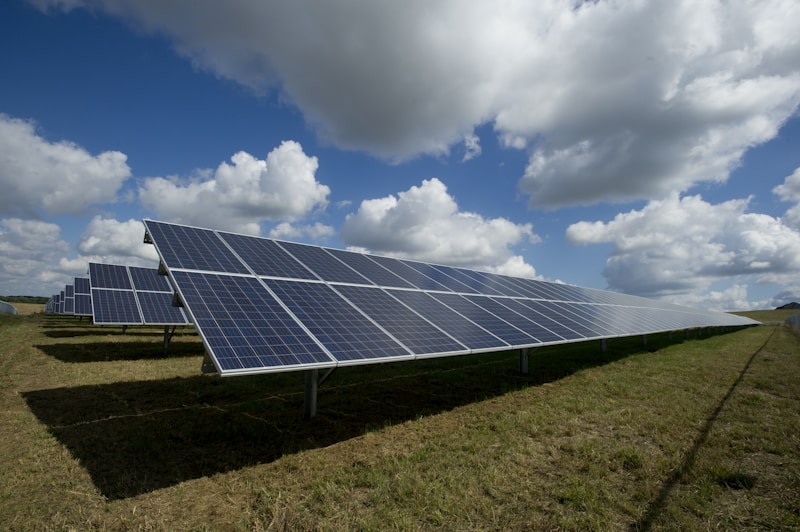
Here's an example image embed (useful for testing image rendering):
Code
Inline code example: use the calculateLCOE() function to estimate cost per megawatt-hour.
A fenced code block without a language:
Capacity Factor = Actual Energy Output / (Rated Power × Time Period)A fenced code block with syntax highlighting (Python):
def levelized_cost_of_energy(capex, opex, discount_rate, lifetime_years, annual_output_mwh):
    """Very simplified LCOE calculation for demonstration purposes."""
    total_discounted_cost = capex
    total_discounted_output = 0

    for year in range(1, lifetime_years + 1):
        discount_factor = (1 + discount_rate) ** year
        total_discounted_cost += opex / discount_factor
        total_discounted_output += annual_output_mwh / discount_factor

    return total_discounted_cost / total_discounted_output


if __name__ == "__main__":
    lcoe = levelized_cost_of_energy(
        capex=1_000_000,
        opex=20_000,
        discount_rate=0.05,
        lifetime_years=25,
        annual_output_mwh=3000,
    )
    print(f"LCOE: ${lcoe:.2f} per MWh")
A fenced code block in JavaScript:
const panels = [
  { id: 1, wattage: 400, orientation: "south" },
  { id: 2, wattage: 400, orientation: "west" },
];

const totalCapacityWatts = panels.reduce((sum, p) => sum + p.wattage, 0);
console.log(`Total array capacity: ${totalCapacityWatts / 1000} kW`);
A fenced code block in JSON:
{
  "project": "Desert Sun Array",
  "capacityMW": 150,
  "location": {
    "lat": 34.05,
    "lon": -118.25
  },
  "commissioned": true
}
Tables
Comparison of Renewable Sources
| Source | Capacity Factor | Land Use | Dispatchable | Approx. LCOE (USD/MWh) |
|------------|:----------------:|-----------|:-------------:|------------------------:|
| Solar PV | 15–25% | Moderate | No | 30–50 |
| Onshore Wind | 30–45% | Low | No | 25–50 |
| Offshore Wind | 40–55% | Low | No | 60–90 |
| Hydropower | 40–60% | High | Yes | 30–70 |
| Geothermal | 70–90% | Low | Yes | 50–100 |
Alignment Test
| Left-aligned | Center-aligned | Right-aligned |
|:-------------|:---------------:|---------------:|
| A | B | C |
| Longer text here | Mid | 123456 |
Blockquotes
Renewable energy is not a silver bullet, but it is one of the most powerful tools we have for decoupling economic growth from carbon emissions.
Nested blockquotes:
This is the first level of quoting.
> This is a nested blockquote, often used to show a quote within a quote.
>
> > And a third level, for testing deeper nesting.
A blockquote containing a list:
Key takeaways from the 2025 global energy report:
- Renewables accounted for over 80% of new power capacity
- Battery storage costs fell by double digits year-over-year
- Grid modernization remains the primary bottleneck
Task Lists
Project checklist for a community solar initiative:
- Complete feasibility study
- Secure initial funding
- Finalize interconnection agreement
- Begin construction
- Conduct community outreach event
- [x] Design flyers - [ ] Book venue - [ ] Send invitations
Horizontal Rules
Below are three different horizontal rule syntaxes, all of which should render identically:
Advanced Elements
Definition List (extended syntax)
Photovoltaic (PV) : A method of converting sunlight directly into electricity using semiconducting materials.
Levelized Cost of Energy (LCOE) : A metric used to compare the lifetime cost of different energy generation technologies.
Footnotes
Solar energy adoption has grown exponentially over the past decade.1 Wind power, meanwhile, has seen similar cost declines.2
1: According to IRENA, global solar capacity increased more than tenfold between 2015 and 2025. 2: Offshore wind costs have fallen by nearly 60% since 2010 due to larger turbine designs and improved installation techniques.
Embedded HTML
Markdown often permits raw HTML for cases the syntax doesn't cover:
Click to expand: Frequently Asked Questions
Q: How long do solar panels last? A: Most modern panels are warrantied for 25–30 years, though they continue producing power at reduced efficiency beyond that.
Q: Is wind power reliable? A: Wind is variable, but grid operators increasingly pair it with storage and diversified generation portfolios to maintain reliability.
Emoji and Special Characters (GFM extension)
Renewable energy adoption is accelerating :rocket: — and public sentiment is shifting :earth_africa::sunny:
Special character escaping test: 100% \* efficient, cost < $50/MWh, output > 3000 MWh/year.
Math Notation (if supported by your reader)
Inline math: $E = mc^2$
Block math:
$$ \text{Capacity Factor} = \frac{\text{Actual Annual Output (MWh)}}{\text{Rated Power (MW)} \times 8760 \text{ hours}} $$
Conclusion
The transition to renewable energy is neither instantaneous nor uniform — it varies by geography, policy environment, and available capital. But the trajectory is clear: costs continue to fall, technology continues to mature, and public and political will continues to build. Whether through a rooftop solar panel, a community wind cooperative, or a massive offshore array, the way we power our lives is being rewritten in real time.
If your Markdown reader has rendered every section above correctly — headings, emphasis, lists, links, images, code blocks, tables, blockquotes, task lists, horizontal rules, footnotes, embedded HTML, and extended syntax like definition lists and math — then it's handling a strong majority of what real-world Markdown content requires.
End of test document. Total sections: 11. Word count: approximately 1,000+ words of body text, plus syntax samples.
O'xshash maqolalar
Hozircha o'xshash maqolalar yo'q.